Social Media
Follow us for the latest updates.


Follow us for the latest updates.
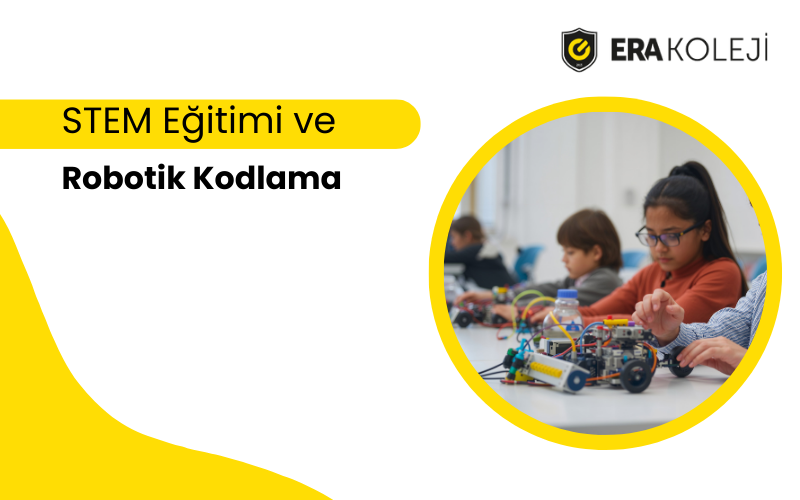
Nowadays, technology and digital developments are increasing rapidly. While science continues to gain momentum in the development of professions. Now Not only the information, but also the way the information is processed makes a difference when learned. STEM The question "What is education?" also provides information on this subject through problem solving, critical future who want to stand out by combining thinking and creativity is gaining importance for adults.
Combining knowledge with creativity and Establishing a comprehensive education philosophy and bringing it to the fore in STEM education is coming out. STEM i.e. Science, Technology, A discipline of Engineering and Mathematics It is an approach created by coming together. Traditional education methods On the contrary, with STEM these four fields are handled together rather than independently. is taken. 21. Practical problem solving required by 21st century skills talent is gained through STEM skills.
Thanks to this holistic approach, especially secondary school students' analytical and creative thinking skills at an early age. development is possible. Understanding the basic principles of science, technology to use it effectively, to understand engineering design processes and to use mathematical Using the power of thinking is possible by developing STEM skills. Among the requirements of the digital age, basic coding skills are also required in STEM. It is such a valuable achievement. Knowing how algorithms work, students It will enable them to become producers rather than just using them. This In this way, young people can be successful not only in school life but also in many areas of life. they can be.
The digital age has transformed many areas of life. continues to transform. From communication to industry, from education to health Transformation in various fields has accelerated with digital innovations. STEM technologies and coding skills are also processes that transform the digital age. It has an indispensable position within the STEM education provides students not only with It teaches not only how to use technology but also how to be a producer. coding, writing a series of instructions that tell a computer what to do process. However, it is also a practice that develops logical thinking. provides.
Robotic coding and STEM is integrated into the curriculum thanks to basic coding courses and Important skills begin to be acquired at this age. Students robotic coding and In STEM educationScratch, Languages like Python or Arduino, LEGO Mindstorms New experiences during the development process by using robotic sets is winning. Thanks to practical experiences, students gain theoretical knowledge While their interest in learning increases, they also have the chance to experience what they have learned in practice. It is possible. In this way, how software and hardware work together It is easily understood.
Coding only for future developers but also the systematic thinking that people from every profession will need It also improves your skills. Digital literacy is no longer a luxury. Digital The development of skills is a basic skill brought by the age. In this way, the future Speaking the language of the new world accelerates in their profession. In global competition Domination at the level of producing digital technologies provides a significant advantage
The most important part of social development and progress One of the indicators is that we are at a stage that produces technology, not consumes it. is to position. Robotic coding is exactly with this vision of producing generation. It is the product of a co-evolving process. Students' own robots designing, building and programming is not just a hobby for them, it's It provides the ability to manage and control complex systems.
Robotic coding process, takes students through a real engineering cycle:
Thanks to this cycle, children also experience failure learns that he/she is a part of the learning process. Learning by trial and error processes are reshaped. Code not working or robot not moving Through processes such as this, the child understands that there is no problem. To solve this problem, new tries to find ways. Children should be patient in this process and get a result. He/she also learns collective work awareness.
Robotics workshops usually include amaker It is combined with the concept of workshopthat is, manufacturer workshop. Maker workshops, By combining students' traditional handicrafts with modern technology with all kinds of materials, from wood to metal, from 3D printing to electronic circuits They are safe and supportive environments in which to work.
Algorithmic thinking skill in children, in its simplest definition, is the ability to solve a problem or achieve a certain goal. Creating a logical and sequential road map step by step to achieve skill. Thanks to this skill, children can study computer science or robotic coding. One of the keys to being successful not only in their fields but in every aspect of life de kazanmış olur. The basics of STEM education with algorithmic thinking One of the tiles is gained as a skill. These competencies that children acquire with a critical role in the future as both academic and professional skills. gets the opportunity to get ahead.
This skill helps the child develop mathematical concepts It is an indication of how you can use it in daily life. The child understands these concepts While applying it in daily life, one should also refrain from planning the steps of scientific experiments. It won't stay. Thanks to these skills that benefit children in many areas, not only not digital, but general problem solving and literacy skills are also supported happens.
What algorithmic thinking brings to children It is possible to list the benefits as follows:
● Small complex problems Develops basic problem solving skills by breaking things down into parts. children overcoming big challenges by separating them through algorithmic thinking learns. In this way, they can overcome the difficulties they face in daily life. They can approach systematically and calmly.
● Children organizing time They learn to sequence tasks. From doing homework to games until learning the rule in a sequential manner, spreading the tasks over time and Prioritizing is possible with algorithmic thinking skills.
● An algorithm performs a certain sequence and follows logic. Because of this necessity, children understand both logical and Understands the skill of systematic thinking and what the cause and effect relationship is. learns. Children learn the cause and effect relationship in more detail, They also gain the ability to analyze in a certain order.
● Conditional expressions such as “if”, “then” and loop-related expressions such as “repeat that” learns concepts. This strengthens their reasoning muscles.
● Errors made during the coding process Debugging, that is, finding out why an algorithm is not working, is critical. Error The process called Debugging, instead of giving up when there is a problem It provides an approach such as finding the source of the problem and fixing it. In case of a glitch that causes the algorithm to stop working, the process is meticulously It is solved in detail and focused.
● Algorithmic thinking skills It is not only useful in solving existing problems. new to kids producing solutions, designing products and making these products functional It also teaches you how to use it in many areas. These systems allow children to not only consume not only in a productive way but also in developing their own robots, projects and applications. This creative process maker atelier It also fosters the culture of trial and error that underlies the concept.
● 21. Familiarity with 21st century skills in the global competition regarding the child's education both academically and professionally. It is possible to take place. There is a connection between these skills and personal development processes. By supporting the process of collaboration, communication and critical thinking, the child can Gains the ability to express himself better in different areas.
● Algorithmic thinking skills The developing child identifies problems more easily. Besides, problems It also progresses in designing the solution for the problem. Testing the result In these steps, it becomes easier for them to interact with their peers.
The application of theoretical knowledge in the practical field as an answer to the question "What is STEM education?" It can be said. Bringing together science, technology, engineering and mathematics STEM applications emerged with a multidisciplinary approach. interest. These disciplines are independent of traditional education methods. are considered as a whole, not separately from each other. 21. century skillsplay an integral role in the development of skills that come with STEM education. plays. This approach aims to solve problems in the real world by using knowledge. It aims to gain the ability to produce.
Thanks to STEM applications, children are They can produce practical solutions to the problems they see. One of the solution They also take an active role in learning processes by doing and experiencing. To understand the laws of nature and how they work in the field of science and engineering Theoretical foundations for understanding are possible with STEM education. like movement To produce a product using the basic principles of physics, various methods such as selecting materials or optimizing the design It is possible thanks to their training.
Use technology only in engineering solutions Using STEM in an integrated manner, not only in the field of technology and mathematics, It is included in the content of the question "What is education?" Especially robotic coding trainings It is one of the most distinctive trainings in this field. This is the data coming from the sensors Using graphs and statistics to analyze in robots is also STEM on the integration of mathematics with technological applications It is an example of the application's use in real life.
As ERA College, in Technology Workshops Areas of experience where students can put their theoretical knowledge into practice We design. These workshops encourage students to think critically and develop concrete projects. as dynamic learning environments that can be designed in the center of creativity takes. Developing students' active skills by transcending traditional learning boundaries It combines the requirements of the digital age. With the maker workshop concept Designed workshops play an important role in the acquisition of 21st century skills. Within the scope of technology workshops, the basics ofInnovative Education System (YES) “Information, Media and Technology” skills, one of the cornerstones of It supports the academic and social development of students.
The basic skills applied in our workshops are as follows: It is possible to glaze as follows: